

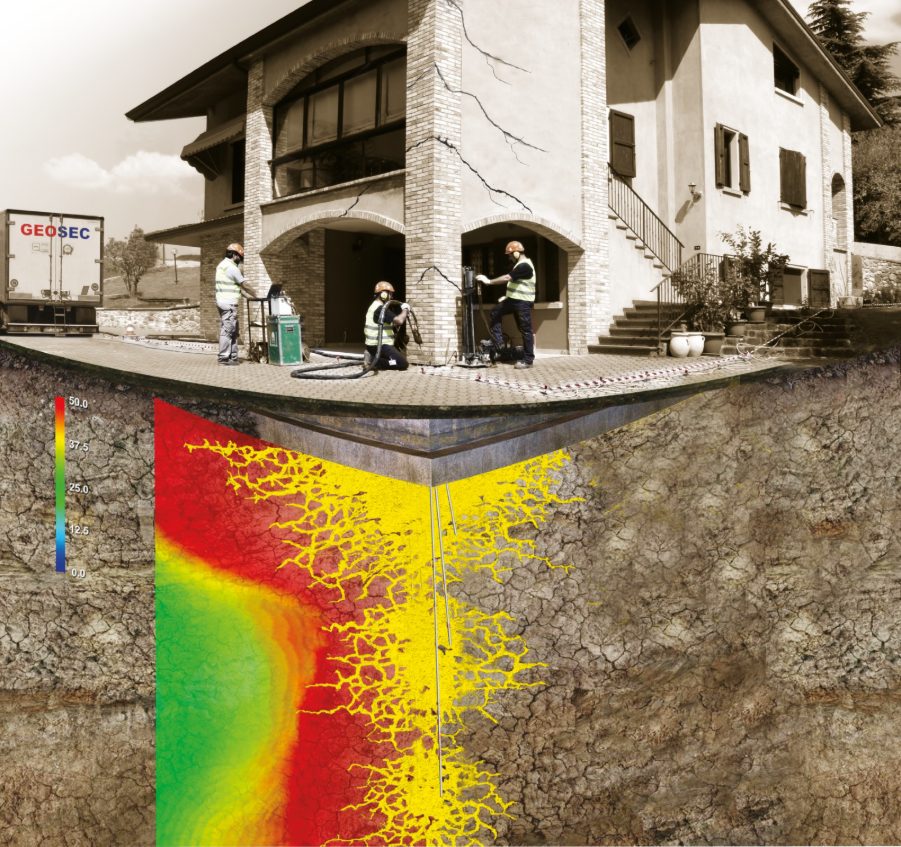
Subsidence is often the visible consequence of a problem developing below ground. Cracks, uneven floors, differential settlement and local changes in level may indicate that the soil supporting a building has lost stability. In these situations, understanding the origin and extent of subsidence is essential before choosing an intervention.
Electrical Resistivity Tomography, commonly known as ERT, has become a useful non-invasive technique for investigating subsidence. It provides an indirect image of the electrical behaviour of the ground, helping specialists identify anomalies associated with moisture, cavities, loss of material, washout of fines or changes in soil composition.
The causes of subsidence can vary significantly from one site to another. Leaking pipes, prolonged water infiltration, poorly compacted fill, clay shrinkage and underground voids can all weaken the supporting ground. When this process is uneven, different parts of a slab or structure may move at different rates.
The main challenge is not only confirming that subsidence is occurring, but determining where the affected area is located and how far it extends. Traditional investigations such as boreholes and trial pits provide valuable information, although they only examine specific points.
ERT allows engineers to analyse a larger volume of ground without extensive excavation. This broader view can be particularly valuable when subsidence is related to irregular moisture patterns or hidden cavities that may not be detected through isolated testing.
How Electrical Resistivity Tomography works
ERT uses electrodes positioned along the surface to introduce a controlled electrical current into the ground. The resulting measurements are processed to create a model showing variations in electrical resistivity at different depths.
Different materials generate different electrical responses. Dry cavities usually produce high-resistivity readings, while wet or saturated ground often shows lower resistivity. These contrasts can reveal conditions associated with subsidence, including water accumulation, weakened fill and underground material loss.
However, tomography does not provide a direct photograph of a cavity. It identifies electrical anomalies that may be compatible with the mechanisms causing subsidence. The results must therefore be interpreted alongside geological information, building history, drainage inspections and visible structural damage.
Detecting moisture and underground voids
Water is one of the most common factors associated with subsidence. Leaking drainage systems, damaged water pipes or poor surface drainage can gradually wash fine particles out of the soil, leaving weakened areas beneath floors and foundations.
Identifying these weakened areas is essential before deciding whether ground stabilisation measures are required to restore the support conditions beneath the affected structure.
ERT can help locate wet zones and possible water pathways. This makes it easier to assess whether moisture is contributing to subsidence and to determine which areas require further investigation.
The technique can also identify anomalies related to voids or decompressed ground. In many subsidence cases, the problem is not a completely open cavity, but a zone that has progressively lost density and bearing capacity.
Supporting a targeted intervention
ERT does not replace conventional geotechnical testing. Instead, it helps make the investigation more focused. By identifying the areas most likely to be affected by subsidence, specialists can position boreholes, penetration tests or inspections more effectively.
The information can also support the design of ground improvement works. Where subsidence is concentrated in specific areas, treatment depths and injection locations can be planned with greater precision, reducing uncertainty and avoiding unnecessary intervention.
Ultimately, Electrical Resistivity Tomography provides a practical way to study subsidence without significantly disturbing the site. Its value lies in improving diagnosis, guiding further testing and helping engineers select a more appropriate response. In complex cases of subsidence, reducing uncertainty is one of the most important steps towards achieving an effective and durable solution.
